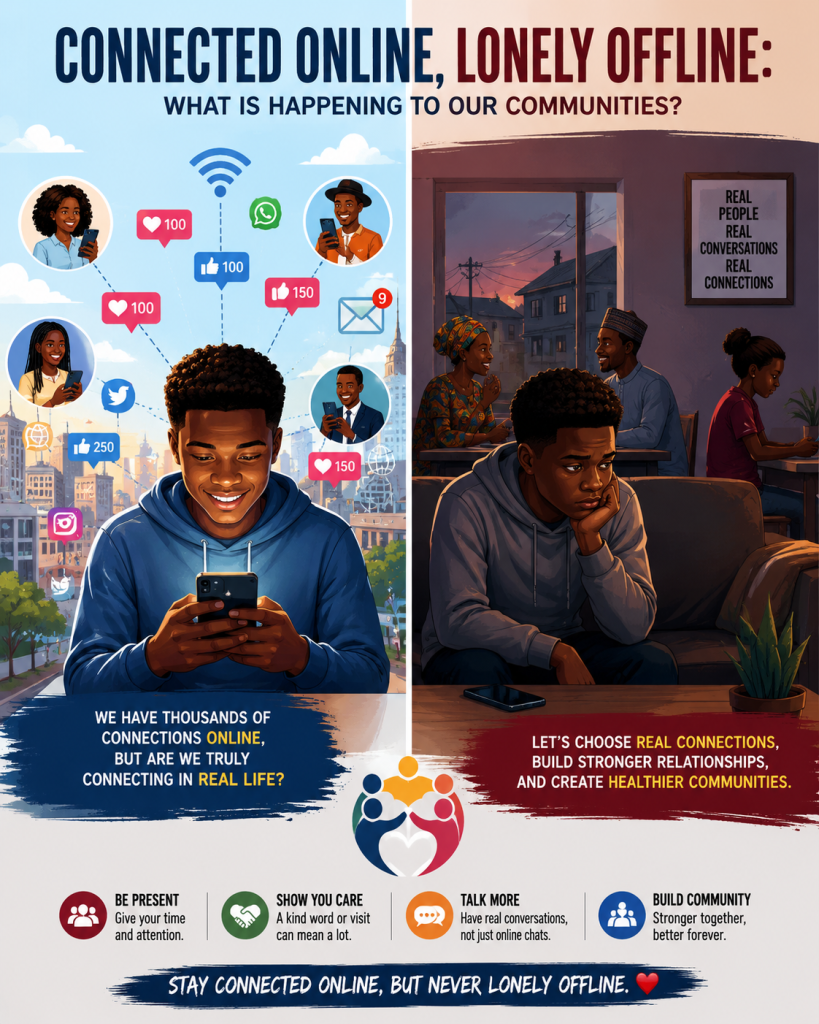
WHAT IS HAPPENING TO OUR COMMUNITIES?
By
Bootyin Alice Peter
How social media is changing friendship, family relationships, and community life in Nigeria.
There was a time when the sound of children playing outside, neighbors exchanging greetings, and families sitting together after dinner was part of everyday life in many Nigerian communities. Friendship was built through shared experiences visiting one another, attending weddings and naming ceremonies, helping during difficult times, and simply showing up when it mattered.
Today, our communities look different.
We are more connected than ever before. With a smartphone and an internet connection, we can speak to someone thousands of kilometers away, share our thoughts instantly, and keep up with events around the world. Social media has opened doors for learning, business, networking, and creativity. It has given many young Nigerians a platform to build careers, promote their talents, and create opportunities that previous generations could only dream about.
Yet, amid all these digital connections, something important seems to be slipping away. Many of us are becoming connected online but lonely offline.
Take a walk through a restaurant, a university campus, religious gathering, or even a family living room. People are physically together, yet emotionally distant. Friends sit at the same table, each focused on a different screen. Families spend hours in the same house without having meaningful conversations. Children know the latest viral trends and characters in cartoons but struggle to build close relationships with the people around them.
Many people now measure connection by followers, likes, comments, and views. A birthday message posted online may replace a personal visit. A quick emoji may take the place of a heartfelt conversation. We often assume someone is doing well because their social media profile looks perfect, forgetting that many people hide pain behind carefully edited photos and cheerful captions.
In Nigeria, where community has always been one of our greatest strengths, this shift deserves our attention.
Our culture has long been built on togetherness. We celebrate with one another, mourn together, and support families during times of need. In many neighborhoods, neighbors once knew each other by name. Elders looked out for children beyond their own families. Young people learned values through regular interaction with parents, relatives, teachers, faith leaders, and community elders. “These everyday relationships created a sense of belonging that no digital platform can fully replace”.
Mental Health reality.
Today, however, many people feel isolated despite being constantly online. Young people often compare themselves to unrealistic lifestyles they see on social media, leading to feelings of unfulfilled, anxiety, and low self-esteem. Adults are not immune either. The pressure to appear successful can become exhausting, leaving many people emotionally drained while trying to maintain an image that does not reflect their reality, this may result to depression and suicidal thought.
The reality:
This is not an argument against social media. The problem is not technology itself. The problem begins when our digital lives replace our real relationships instead of strengthening them.
- Real friendship cannot be replaced by notifications.
- A message cannot always replace a visit.
- A reaction button cannot replace genuine empathy.
- A thousand online followers cannot replace one trusted friend who is willing to sit beside you during life’s difficult moments.
As communities, we need to reclaim the simple habits that once kept us connected. Let us visit our neighbors more often. Let us put our phones aside during family meals. Let us check on friends without waiting for them to post a cry for help online. Let us create safe spaces where young people can talk openly about their struggles without fear of judgment.
- Parents should spend intentional time with their children.
- Schools should encourage meaningful social interaction alongside digital learning.
- Community and faith leaders should continue creating opportunities for people to meet, serve, and grow together.
Every one of us has a role to play in rebuilding genuine human connection.
The strongest communities are not built by technology alone. They are built by people who listen, care, encourage, forgive, and show up for one another.
So, before you spend another hour scrolling through your phone today, ask yourself a simple question: Who in my life needs a real conversation, not just a message?
- Perhaps it is a parent waiting for your call.
- A friend going through a difficult season.
- An elderly neighbor living alone.
- A sibling who simply wants your attention.
Sometimes the greatest gift we can give another person is not our latest post but our presence.
Let us continue to embrace technology, but let us never allow it to replace the relationships that make our communities strong. Because at the end of the day, life is not measured by the number of followers we have, but by the number of lives we genuinely touch.
Let’s stay connected online, but let us never become lonely offline.